Opens the official listing with live dates and prices. Book there; nothing is charged on this site.
Area
Central Copenhagen, Slotsholmen
Theme
History & culture
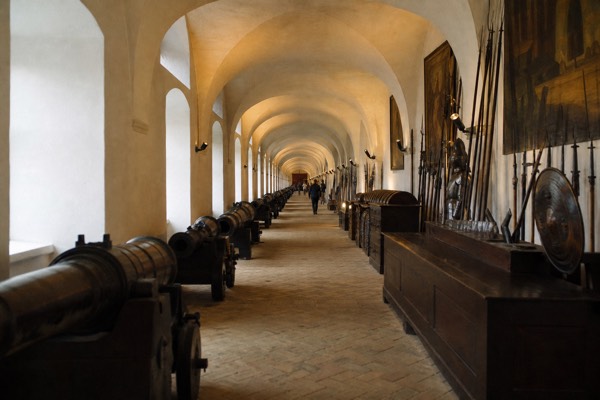
The ground floor is one long vault, 163 metres of it, lined nose to tail with cannons that once armed the Danish fleet and army. This is the Royal Arsenal that Christian IV finished in 1604, and the Danish War Museum, Krigsmuseet, fills it with five centuries of arms. It is quieter than the big palaces nearby, and for anyone who likes their history solid and physical, it hits hard.
What will you see inside the Danish War Museum?
The two showpieces are the ground-floor Cannon Hall, a 163-metre arched gallery packed with historic artillery, and the Armoury Hall upstairs, hung with thousands of swords, muskets and pistols. Around them run 500 years of Danish military history, from Renaissance armour to the Cold War and modern deployments. The building itself, the 1604 Royal Arsenal, is half the story.
You enter into the Cannon Hall, and it lands immediately. The vaulted room stretches away in a single line, one of the longest arched halls of its kind in Europe, with bronze and iron guns set out along its length. Some are ornate royal pieces cast with monograms and coats of arms, others are workhorse field guns, and together they trace how artillery changed over three hundred years.
Climb the stairs and the mood shifts. The Armoury Hall, the Vabensalen, is where the old arsenal actually stored the army's small arms, and the walls are still arranged with rank upon rank of edged and hand weapons: rapiers, sabres, matchlocks, flintlocks, early revolvers. Seeing them massed like this, the way they were once kept ready for issue, is more affecting than any single case could be.
The upper galleries carry the narrative forward. Uniforms, armour, banners, medals and models set out Denmark's wars from the 1500s through the Schleswig conflicts and the two World Wars, and on into the Cold War and Danish troops serving abroad. There are personal objects too, letters and kit that keep the human scale in view. It is a focused museum with a clear thread, which is part of why it reviews so well.
What gives the place its character is the density. Because the arsenal was a working store, the objects are shown in bulk rather than one to a spotlight, and that changes how you read them. A single sabre in a case is an artefact. A wall of two hundred, racked the way they once were for issue, is an argument about how states armed themselves. Add the smell of old iron and oiled wood in the long hall, and the history stops feeling abstract.
How do Danish War Museum tickets work, and which one should you buy?
There is one ticket, and it covers the whole museum: the Cannon Hall, the Armoury Hall and the upper history galleries. A standard adult ticket is 130 DKK at the door or 117 DKK booked online, and under-18s go free. The War Museum is part of the National Museum, and its ticket is separate from the National Museum's own entry.
Because the collection sits under one roof, there is no tiered ticket to puzzle over. You pay once and see everything, cannons downstairs and weapons upstairs. Booking online trims the price a little and speeds up arrival, though this museum is rarely as busy as the palaces on the same island, so a door ticket is usually fine on a normal day.
If you are here in summer or with a group, it is still worth a glance at the latest dates and prices on the booking panel above, since school groups do come through. Under-18s enter free, which makes it an easy add-on for families already visiting Christiansborg or the National Museum a couple of minutes away. The prices below are the current 2026 figures.
Ticket
Price (2026)
Notes
Adult, booked online
117 DKK
Covers the whole museum
Adult, at the door
130 DKK
Buy on arrival
Under 18
Free
Full access
National Museum ticket
Separate
The two sites are ticketed apart
Why does the Royal Arsenal building matter?
The museum lives inside the Tojhus, the Royal Arsenal that King Christian IV built between 1598 and 1604 to arm his navy and army. It is one of the oldest arsenal buildings in Europe still standing, and the vast Cannon Hall was designed to hold artillery from the day it opened. The setting is not a backdrop, it is an exhibit in itself.
Christian IV was the great builder-king of Copenhagen, and much of the city's early skyline came from his reign, from Rosenborg Castle to the Round Tower. The arsenal was the practical heart of that ambition: a place to store guns, powder and weapons beside the old naval harbour on Slotsholmen. Walking the Cannon Hall, you are standing in a working military store that is more than four hundred years old.
The location tells you why. Slotsholmen was the seat of Danish power, and the arsenal sat right beside the royal castle and the fleet's moorings, so weapons could move straight to the ships. Today the Black Diamond of the Royal Library and the library garden are next door, which makes the approach unexpectedly peaceful for a building with such a hard-edged purpose. There is a good historical summary on Wikipedia.
How long do you need at the Danish War Museum?
Most visitors spend about one to one and a half hours here. An hour is enough to walk the Cannon Hall, take in the Armoury Hall and pass through the history galleries at a steady pace. Give it ninety minutes or more if you read the labels, photograph the guns, or bring older children who want to look closely.
The natural route is simple: work the Cannon Hall on the ground floor first, since it is the moment that stays with you, then climb to the Armoury Hall and follow the upper galleries through the centuries. Because the museum is compact and clearly signed, you rarely double back, and the single-line Cannon Hall almost pushes you along its length.
It slots neatly into a wider Slotsholmen morning. Many people pair it with Christiansborg next door or the National Museum across the canal, so an hour here fits between larger stops rather than swallowing a day. If military history is your main interest, though, it is worth slowing down, as this is one of the richer arms collections in northern Europe.
Photographers should budget a little extra. The Cannon Hall is a genuinely dramatic space, and a clean shot straight down its length, without a group in the frame, is far easier early in the day. The same goes for the massed weapons upstairs, where the sheer repetition of the racks is the picture worth taking.
Know before you go: hours, closed days and getting there
The War Museum is at Tojhusgade 3 on Slotsholmen, next to Christiansborg and the Royal Library. From April to September it opens daily 10:00 to 17:00; in the winter months it closes on Mondays. The nearest Metro is Gammel Strand on the M3 and M4 lines, a few minutes' walk across the canal. Under-18s enter free.
Reaching it could hardly be simpler. Gammel Strand Metro is the closest stop, Copenhagen Central Station is about a ten-minute walk, and the whole of Slotsholmen is flat and walkable. The entrance sits on the quiet side of the island near the library garden, so it is easy to miss if you are looking for a grand facade, since the building reads as a long low arsenal rather than a palace.
Practical notes: bags go in the cloakroom, the Cannon Hall floor is even and step-free, and photography without flash is fine. The winter Monday closure is the main thing to check before you set out. The at-a-glance table below covers the essentials, and the museum's live hours sit on the National Museum group site.
At a glance
Detail
Address
Tojhusgade 3, Slotsholmen, central Copenhagen
Nearest station
Gammel Strand Metro (M3, M4), few minutes' walk
Hours (Apr-Sep)
Daily 10:00-17:00
Winter
Closed Mondays
Under 18
Free entry
Part of
The National Museum of Denmark
What can you pair with the Danish War Museum nearby?
Everything worth pairing is within a few minutes' walk on Slotsholmen. The obvious combinations are Christiansborg Palace next door, the National Museum of Denmark just across the canal, and Rosenborg Castle a short walk or Metro stop north for the crown jewels. The Copenhagen Card covers the palaces and the National Museum in the same cluster.
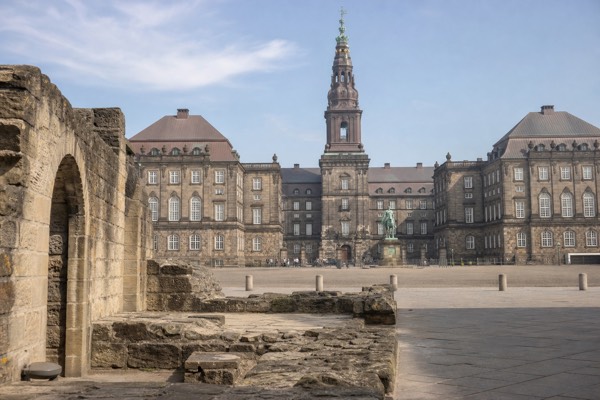
Step straight out to Christiansborg Palace, where a single bundle takes in the Royal Reception Rooms, the medieval ruins beneath the courtyard and a tower with a free view over the city. It is the natural next door from the arsenal, since both sit on the same island of power. From there the National Museum of Denmark is a two-minute walk over the canal, running from the Vikings to the present.
For a change of register, walk north to Rosenborg Castle and the crown jewels in the King's Garden, another building from Christian IV's reign. A Copenhagen Card ties the group together and covers the transport between them, and you can check exactly what is included on the Copenhagen Card site.
Questions people ask
How much are Danish War Museum tickets in 2026?
A standard adult ticket is 130 DKK at the door or 117 DKK booked online, and it covers the whole museum. Under-18s enter free. The War Museum is part of the National Museum but ticketed separately from it.
What is the cannon hall at the Danish War Museum?
The Cannon Hall is the museum's ground floor, a single vaulted gallery about 163 metres long, lined end to end with historic artillery. It is one of the longest arched halls of its kind in Europe and dates to Christian IV's 1604 Royal Arsenal.
Is the Danish War Museum worth visiting?
For anyone interested in history, arms or architecture, yes. The 163-metre Cannon Hall and the wall-to-wall Armoury Hall are hard to match, the 1604 building is an exhibit in itself, and it is far quieter than the palaces nearby. It reviews very well.
How long should I spend at the Danish War Museum?
Most visitors need about one to one and a half hours. An hour covers the Cannon Hall, the Armoury Hall and the upper history galleries at a steady pace, while military-history enthusiasts can happily spend longer.
Is the Danish War Museum open on Mondays?
From April to September it opens daily, including Mondays. In the winter months it closes on Mondays. Because holiday hours can shift, check the exact date on the official site before you go.
Is the Danish War Museum good for kids?
Older children who like knights, cannons and history usually take to it, and under-18s enter free. The long Cannon Hall is easy to walk with a pushchair, and it pairs well with Christiansborg or the National Museum next door for a family morning.
How do I get to the Danish War Museum?
It is at Tojhusgade 3 on Slotsholmen, next to Christiansborg and the Royal Library. The nearest Metro is Gammel Strand on the M3 and M4 lines, a few minutes' walk, and Copenhagen Central Station is about ten minutes on foot.
Central Copenhagen, Frederiksholms Kanal · Denmark's story from the Vikings to now
Denmark's largest cultural-history museum runs from Stone Age tools and the Sun Chariot through a world-class Viking hall and into ethnographic and modern collections. Adult admission is now paid; under-18s go free.
Central Copenhagen, Romersgade · Everyday Danish life since the 1800s
The story of ordinary working Copenhageners, set in the original 1879 workers' assembly hall, with a preserved family apartment, a period coffee shop and strong social-history exhibitions. An easy, human counterpoint to the palaces.
Rungsted (day trip, ~30 min by train) · Out of Africa, at the writer's home
The coastal home at Rungsted where Karen Blixen, the author of Out of Africa, was born, wrote and is buried. The house is kept as she left it, set in a bird sanctuary that runs down toward the sound.